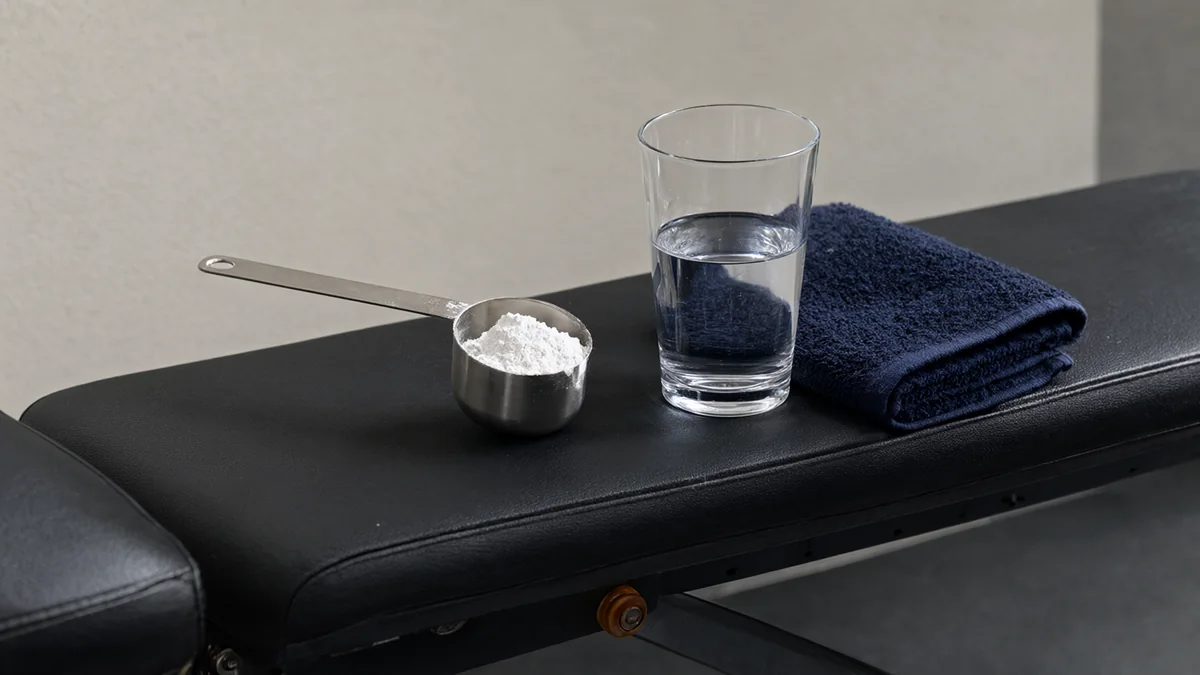
The scale goes up after you start creatine. That number is real, but its meaning is not obvious. It may include a water change, and over a longer training period it may also include tissue changes. The scale cannot separate those components, and an increase does not automatically mean you gained body fat.
Creatine is an exercise-performance supplement, not a weight-loss medicine. It cannot guarantee fat loss, and taking it is not a substitute for a sustainable eating pattern or resistance training. The most useful question is what you hoped it would help you do, and which observations would show that benefit.
Start with what creatine does
Creatine helps the body supply energy for brief, demanding muscular efforts through the phosphocreatine system. The NIH Office of Dietary Supplements describes benefits most consistently for repeated high-intensity activity, including weight lifting, with variation between individuals. That is a performance effect; it does not mean creatine burns body fat directly.
This distinction changes how to judge the supplement. Someone using it to support a training program might care about completing comparable work and recovering well enough to keep training. Someone expecting an appetite-suppressing or rapid weight-loss effect is asking for a benefit the evidence here does not establish.
Before interpreting a new scale result, write down why you started, the start date and any simultaneous changes. Beginning resistance exercise, changing meals and adding a supplement on the same day makes attribution difficult. A later improvement cannot be assigned to one item with certainty.
Early weight gain: water is a plausible contributor
Creatine can increase body water, particularly early in supplementation. In an older randomized trial of thirty-two young adults involved in resistance training, the creatine group increased body mass and total body water over twenty-eight days. The investigators did not find altered fluid distribution. The original water-compartment study supports water as a contributor to weight gain, without proving that every person’s increase is entirely water or confined to one compartment.
A peer-reviewed evidence review also distinguishes short-term water changes from longer studies, where results are less uniform. A universal forecast such as “everyone gains the same amount in the first week” would go beyond that evidence.
You do not need to convert an unexpected weigh-in into an immediate calorie cut. First check whether conditions were comparable and whether the timing coincides with the supplement or another change. Ordinary variation still occurs alongside creatine use; the supplement does not explain every fluctuation.
Later changes: lean mass is not a muscle-only measurement
Over weeks or months of resistance training, creatine may add to measured lean-body-mass gains. A 2024 resistance-training meta-analysis in adults younger than fifty found an average additional increase compared with resistance training without creatine. That result describes a group difference, not what every participant gained.
Lean body mass and fat-free mass are not exact synonyms for newly built skeletal muscle. They include water and other non-fat components, with definitions depending on the measurement method. It is therefore inaccurate to rename the entire extra lean-mass result “new muscle.” The broader 2024 body-composition review specifically noted limited water measurements, which restricted its ability to explain how much of a change reflected water versus tissue.
Even DXA can show apparent lean-tissue changes when hydration and glycogen conditions differ. A small experimental study demonstrated this in active young men; it was not a creatine trial. Use a repeatable measurement protocol rather than subtracting a guessed “water allowance” from a scan or home-scale estimate.
Muscle development is better approached as a training outcome over time. Record exercises and comparable performance alongside any composition assessment. Improving performance is valuable, although it does not identify exactly how much tissue changed. Our strength training guide explains how to give those observations useful context.
Does creatine cause fat gain or help fat loss?
The broad 2024 review of creatine protocols found small average increases in body mass and fat-free mass, but no statistically significant pooled change in absolute fat mass. Its small reduction in body-fat percentage needs careful interpretation: percentage can fall when non-fat mass increases, even if the amount of fat is unchanged.
The narrower 2024 resistance-training review found small average reductions in both fat mass and fat percentage compared with training without creatine. These reviews used different eligibility criteria and study sets. They should not be collapsed into a promise that creatine always reduces fat, or dismissed because their fat-mass findings differ. Neither establishes a dependable weight-loss effect for an individual taking a supplement without the studied training context. See the broader review and the training-specific review.
Here is a hypothetical arithmetic example, not a study result or a prediction. If someone has 20 units of fat in 100 units of total mass, the proportion is 20%. If total mass rises to 102 while fat stays at 20, the proportion becomes about 19.6%. The percentage fell without fat loss. This is why “lower body-fat percentage” and “less body fat” need separate checks.
A decision table for an unexpected scale increase
This table is an editorial interpretation aid, not a method for diagnosing fluid retention or measuring muscle. Consider the pattern and its context before making a decision.
| Observation | What remains uncertain | Next useful check |
|---|---|---|
| Weight rises soon after starting creatine | Water could contribute; the scale cannot partition water, fat and tissue. | Check timing, comparable weigh-ins and simultaneous changes. |
| A device reports more lean mass | Water and measurement conditions may affect the estimate. | Repeat under the device or clinic’s standardized conditions. |
| Training performance improves over time | Practice, the program and supplementation may all contribute. | Compare the same exercise, technique and effort conditions. |
| Fat percentage falls while weight rises | The proportion alone does not prove absolute fat loss. | Read the actual outcome measured and its uncertainty. |
| Weight keeps changing beyond the early period | A single cause cannot be assumed. | Review the longer pattern, symptoms and broader routine. |
Keep a useful record without chasing every number
Choose a simple log: date, supplement start or change, comparable weight observations if useful, and one or two repeatable training measures. Add a brief note about unusual meals, travel or a change in exercise. Avoid changing several parts of the routine merely to correct one number.
Use the same scale and consistent conditions when comparing readings. For body-composition testing, follow the assessment provider’s preparation instructions and tell them about creatine use. The goal is comparability, not manipulating food or fluids to produce a preferred result. Body weight fluctuations explains why short-term scale changes need context.
If your main objective is losing fat, assess the eating pattern and activity plan independently of the supplement. Protein during weight loss and sustainable weight loss planning address those foundations. Creatine use does not make an unsuitable calorie restriction appropriate.
Safety and suitability are a separate question
Healthy-adult evidence should not be generalized to everyone. If you have kidney disease, take medicines or have a condition affecting fluid balance, discuss creatine with your clinician or pharmacist before starting; this article does not set a personal dose. Tell the clinician interpreting kidney tests that you use it. Creatine metabolism can affect creatinine, a marker used in kidney assessment, so a result needs clinical interpretation rather than self-reassurance that an abnormal value is “just creatine.” The kidney-function review discusses this distinction.
Do not automatically explain new swelling or other concerning symptoms as ordinary supplement-related water gain. Seek assessment. This also avoids the opposite error: treating every small, symptom-free scale rise as evidence of illness.
Common questions
Can I tell how much of my gain is water?
Not from a bathroom scale. Timing can help form a hypothesis, but it cannot measure the separate components. A fixed deduction would create false precision. Consistent records are more useful than inventing a water estimate.
Does everyone gain weight?
No uniform response is established. Average changes in trials are not mandatory changes for each person. A smaller scale response also does not by itself prove that the supplement did or did not affect exercise performance.
Should I stop solely to make the scale lower?
A lower reading would not itself demonstrate fat loss or a better training result. Revisit the reason for using the supplement, its suitability and whether a meaningful benefit is evident. If weight changes cause persistent distress, discuss a monitoring approach that supports your wellbeing.
Limits of the evidence
Many studies involve healthy exercising adults, often over relatively short periods. Protocols and measurement methods vary; body-composition outcomes are sometimes secondary. The evidence does not resolve every person’s response, every medical situation or the exact water-versus-muscle contribution to a reported lean-mass gain. It supports a cautious interpretation of weight, rather than a guaranteed physique outcome.