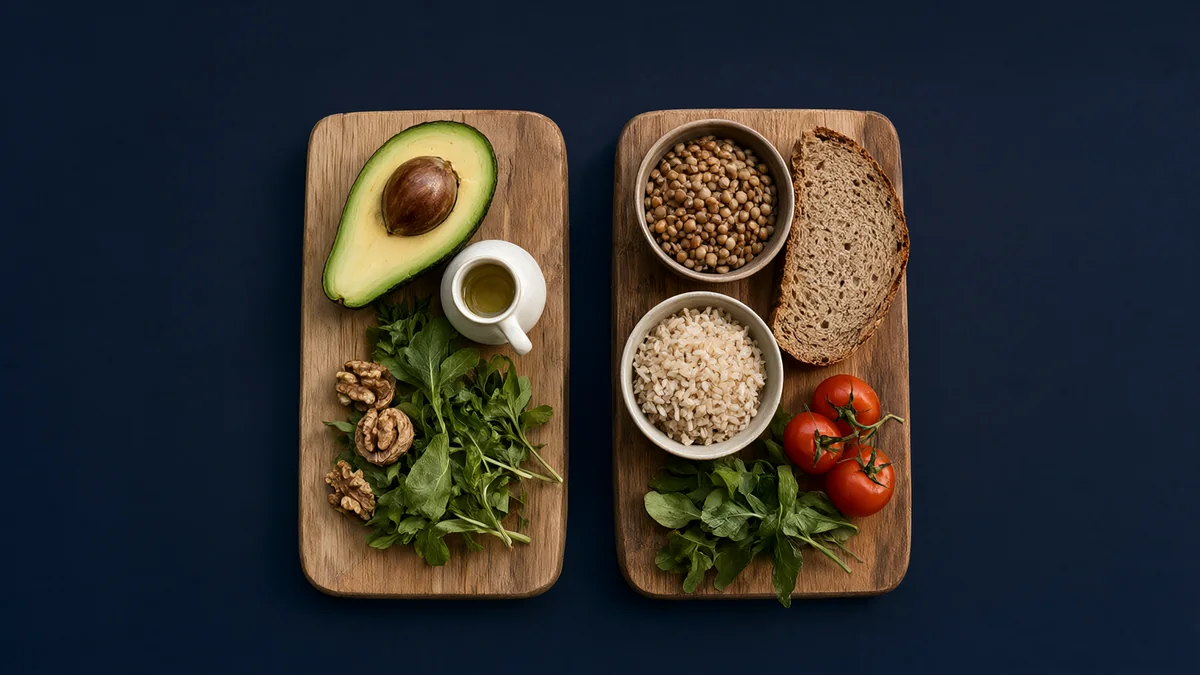
DIETFITS found no statistically significant difference in average weight loss between its healthy low-fat and healthy low-carbohydrate assignments after one year. That result is useful precisely because the study described actual diets and support. It does not mean every product, menu or online challenge carrying either label has been tested.
For someone choosing an eating approach, the next step is to examine the meals it would involve. This guide pairs the trial’s results with a practical comparison sheet, while keeping personal medical dietary decisions separate from the study’s average findings.
Who took part and what support they received
The 2018 DIETFITS randomized trial enrolled 609 adults aged 18–50 with BMI 28–40 and without diabetes. Health educators offered 22 diet-specific small-group sessions across 12 months. Both approaches emphasized food quality and finding a lower fat or carbohydrate intake that participants could maintain.
| Measure | Healthy low-fat | Healthy low-carbohydrate |
|---|---|---|
| Participants assigned | 305 | 304 |
| Mean weight change at 12 months | −5.3 kg | −6.0 kg |
| Mean carbohydrate share of energy at 12 months | 48% | 30% |
| Mean fat share of energy at 12 months | 29% | 45% |
| Mean protein share of energy at 12 months | 21% | 23% |
These are reported group means, not personal targets. The between-group weight estimate was 0.7 kg, with a 95% confidence interval from −0.2 to 1.6 kg. A total of 481 participants, or 79%, completed the trial. The original report provides the definitions and analyses behind these summaries.
Read the diets people followed, not just their names
The actual macronutrient distributions show why a label needs context. The lower-carbohydrate assignment still averaged 30% of energy from carbohydrate at 12 months. It should not automatically be described as the same intervention as every ketogenic diet or every plan that excludes a particular food group.
Likewise, a low-fat label says little about the quality, variety or practicality of an eating pattern by itself. To judge whether another program resembles DIETFITS, look for its foods, level of restriction, education and follow-up. Attaching the trial’s name to a packaged product does not establish that the product reproduces the intervention.
A useful question for a program provider is: “Which parts of your plan match what participants actually did?” A concrete answer might identify education, meal preparation and ongoing support. A vague answer that repeats only “low carb” or “low fat” leaves the comparison incomplete.
No significant difference does not mean identical results
The confidence interval around the between-group estimate crosses zero. The trial did not establish that one assignment produced greater average weight loss. That does not prove mathematical equivalence or predict that two particular people would experience the same outcome.
Group means also cannot select a diet for an individual. Choosing the group with the larger rounded loss and promising that extra amount to a reader confuses an uncertain average comparison with a personal forecast. The useful finding is that these two supported approaches did not have an established average winner on the primary weight outcome.
There is still a real decision to make: which approach can meet a person’s needs and fit their circumstances? That requires information about the person and the proposed food pattern, rather than an attempt to extract a universal winner from the table.
The precision-nutrition result was specific
The researchers tested whether a particular genotype pattern or baseline insulin-secretion measure helped identify which assignment worked better. Neither hypothesized interaction was statistically significant. The trial did not validate those tested matching strategies.
It did not test every possible genetic marker or every form of individualized care. If someone cites DIETFITS to sell a diet-matching test, ask whether that exact test has prospective evidence showing better outcomes when used to guide care. If someone uses it to dismiss all tailored dietary advice, ask how the tested hypotheses could support such a broad conclusion.
Preferences, allergies, medication use and medical conditions remain practical facts to consider even when a proposed laboratory matching method is unproven. Keeping those questions separate prevents “personalized” from becoming either a marketing guarantee or an empty word.
Compare two ordinary days of meals
Use the following as an editorial discussion aid, not a prescribed menu or nutrition score. Describe a realistic workday for each approach, including drinks, snacks and what happens when cooking is difficult.
| Decision | What to write down for each approach | What an incomplete answer misses |
|---|---|---|
| Meals | Actual breakfast, lunch and dinner options you would eat | A nutrient slogan is not a meal |
| Variety | Sources of vegetables, fruit, protein and other needed foods | Removing a food leaves a replacement question |
| Budget and access | Shopping cost, equipment, storage and preparation time | A plan must survive an ordinary busy day |
| Support | Who can help with questions and follow-up | A downloadable menu differs from year-long education |
| Health needs | Questions for your dietitian, clinician or pharmacist | Trial averages cannot clear an individual medical restriction |
For example, a person who usually takes a bean-and-vegetable lunch to work can examine how each proposed approach would change it. Which ingredients stay? What replaces anything removed? Does the replacement need refrigeration or more preparation? This is an invented planning example, not evidence that one version will produce more weight loss.
WHO guidance emphasizes dietary adequacy, balance, moderation and diversity, including nutritious sources of carbohydrate and attention to fat quality. Those principles add information that the diet labels omit. The protein guide provides food examples, while meal planning for a busy week addresses preparation constraints.
Decide how to review the choice
Before starting, discuss which outcomes matter and how follow-up will work. Weight may be one measure, but tolerability, nutritional adequacy, relevant clinical measures and the ability to continue also belong in the review. A plan that repeatedly creates problems deserves reassessment.
Be especially careful when a major dietary change could affect an existing medical treatment. DIETFITS excluded diabetes; it cannot establish medication safety for someone managing diabetes. Obtain individualized advice rather than applying the trial’s group percentages as an instruction.
The study’s most useful contribution is a better question: what supported eating pattern can you actually use? Answering it takes more detail than choosing a team in a diet debate.