“One serving” sounds like advice, but on a US Nutrition Facts label it has a more specific purpose. It sets the amount used to report calories and nutrients, based on customary consumption. Your portion is the amount you actually eat or drink. Confusing the two can make a label seem more precise, or more judgmental, than it is. A few simple checks turn the panel into useful information without making every meal an accounting exercise.
Locate the amount before reading the numbers
Start at the top of the panel: serving size and servings per container. The FDA serving-size guide explains that US serving sizes are based on amounts people typically consume. They are not recommendations about how much a particular person should eat.
A package may contain several servings even when it looks like a convenient individual purchase. Some packages show separate columns for one serving and the whole container. Check which column you are reading before comparing calories, protein or sodium with another food. The amount is part of the number.
Portion and serving are useful different concepts
Suppose you choose a portion larger than the listed serving. That does not automatically make it wrong. It means the panel’s figures need to be adjusted if you want to estimate that portion’s nutrients. Your needs, the meal’s other foods and clinical circumstances determine whether the amount is appropriate.
Likewise, a smaller portion is not automatically healthier. It may be too little for the meal’s role. Keep the descriptive task separate from the personal decision: first understand what is in the amount; then consider how that amount fits your plan. A food label cannot perform both jobs by itself.
A made-up example shows the arithmetic
Imagine an illustrative packet containing two label servings. Each serving lists 180 calories and 6 grams of protein. Eating the whole packet would correspond to 360 calories and 12 grams of protein using those label values. Eating half the packet would correspond to one serving. These are fictional arithmetic figures, not facts about a real product.
The same scaling applies to other listed nutrient amounts. If your portion does not match a simple fraction, an approximate comparison may be enough for ordinary planning. Precision has a purpose only when it answers a useful question; it should not be confused with certainty about every aspect of nutrition.
Compare equal amounts when the question requires it
Two foods can appear quite different because their labels use different serving sizes. Before deciding one has more fiber or sodium, check the amounts being compared. The FDA label guide explicitly advises matching serving sizes when comparing products.
Sometimes the relevant comparison is instead the portion you usually eat: one whole container versus another. State which comparison you are making. Equal-weight comparisons describe nutrient concentration, while usual-portion comparisons describe a practical choice. Neither automatically identifies the better food for all people and situations.
Understand what percent Daily Value is doing
Percent Daily Value indicates how much of a reference daily amount is contributed by one listed serving. FDA describes 5% DV or less as low and 20% DV or more as high for a nutrient. Those are general label-reading conventions, not diagnoses or personalized targets.
The percentages do not add vertically to a single score. A product might contribute fiber, sodium and calcium in different proportions. Read the nutrients relevant to your question rather than looking for one overall percentage. People with clinical dietary needs may have targets that differ from the label references and should use their care team’s guidance.
The 2,000-calorie reference is not your prescribed intake
The label uses 2,000 calories as a general reference for nutrition advice. FDA notes that individual calorie needs may be higher or lower. Age, body size, activity and other circumstances matter. The reference does not establish how much you should eat for weight maintenance or weight loss.
If you need an individualized intake plan, ask a qualified professional how it was determined and how it should be reassessed. Our article on changing energy balance explains why needs and body-weight responses are not fixed. A familiar label number should not become an arbitrary personal ceiling.
A front-of-pack claim is only the beginning
A package may highlight protein, fiber or the absence of one ingredient. Turn it over and check the serving amount, the broader nutrient panel and the ingredient information relevant to you. A highlighted claim may be accurate while leaving unanswered questions about the portion or the rest of the meal.
You do not need to find a product that wins every comparison. Decide why you are comparing: an allergy, a clinical restriction, convenience, taste, fiber or cost. A focused comparison is easier to make and explain than an attempt to rank foods as universally good or bad.
Use measurement when it helps you learn
Occasionally seeing how your usual bowl compares with the label’s measure can make the information more concrete. You can learn without committing to weighing every meal. Whether ongoing measurement is useful depends on your goals, professional advice and how the activity affects you.
If counting or measuring drives anxiety, compensation or avoidance, discuss alternatives. Labels are tools, and tools should serve the person using them. Someone with an eating-disorder history may need a plan for handling calorie information that differs from a general weight-management suggestion.
Apply the label to the meal as a whole
A label usually describes one packaged food. Your meal may contain several foods, and some may have no panel. Consider what the item contributes and what else the meal needs. A convenient soup can be one component rather than an entire verdict on your eating.
For a practical next step, compare two foods you already buy, note their serving sizes, and answer one relevant question. Keep taste, affordability and medical needs in the decision. Our guide to building satisfying meals offers a flexible way to put that information back into ordinary eating.
Notice whether the panel includes preparation
Some products provide information for the food as sold and for the food prepared according to directions. Read the column headings before comparing them. If preparation includes milk, oil or another ingredient, the prepared figure may depend on a specified amount and type. Your own recipe can differ from that assumption.
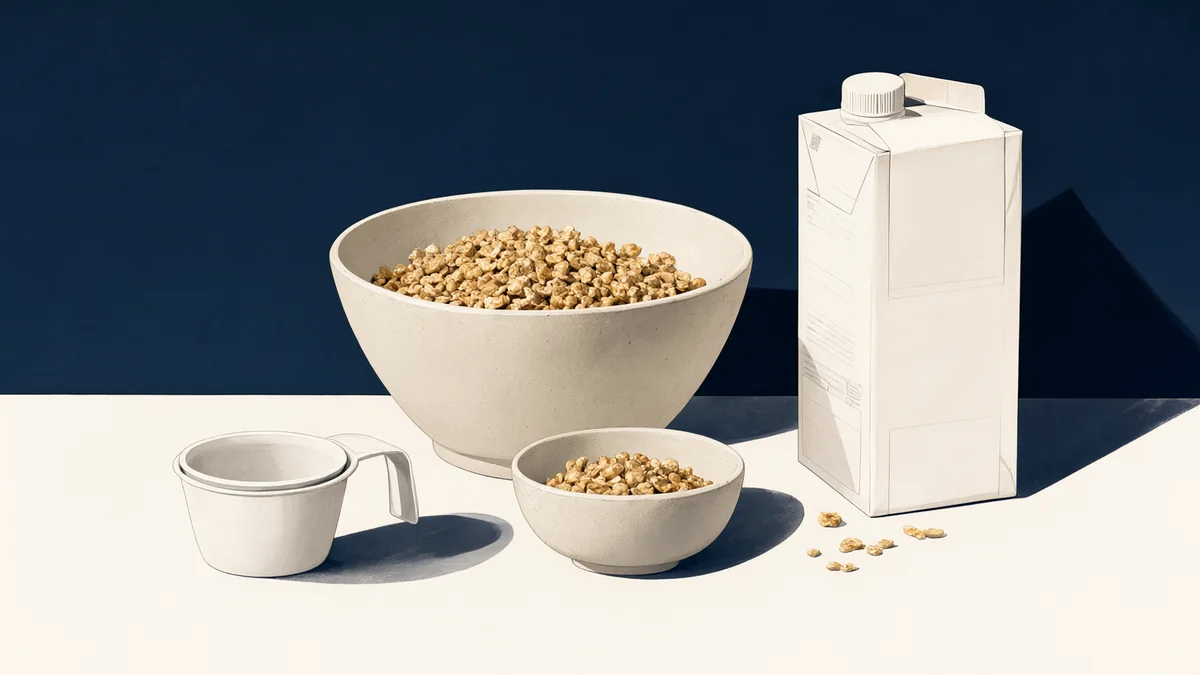
For an illustrative cereal comparison, first identify whether both figures describe the dry cereal alone. If one includes an added ingredient, you are comparing different combinations. You can still choose either product; the question is whether the numbers answer the question you intended to ask. Keep the amount, preparation and added foods together when using label information in an ordinary meal.