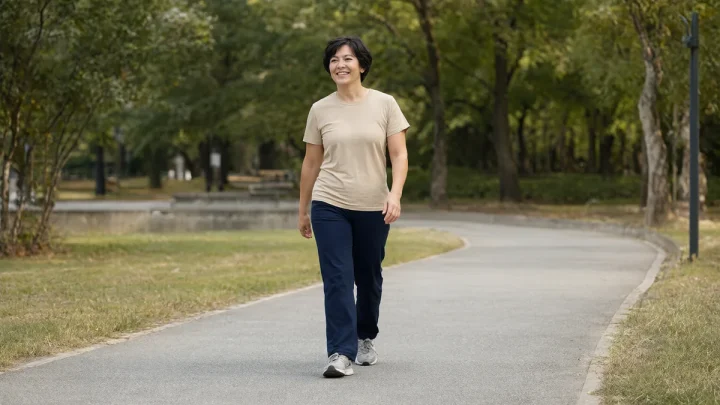
Running is usually the more time-efficient way to accumulate vigorous aerobic activity. Walking is easier to fit into many ordinary days. For weight management, that creates a useful distinction: the activity that feels harder is not automatically the activity you can repeat most reliably.
There is no universal winner for fat loss. A large observational study found a stronger association between running and changes in body weight than walking, but it did not randomly assign people to the two activities. Your available time, current fitness, comfort and actual weekly activity matter alongside food intake. Here is how to compare the options without treating a calorie display as a prediction.
The short answer: compare a whole week, not one workout
If you already tolerate running and enjoy it, running can be an efficient aerobic option. If you are returning to activity, prefer walking, or cannot comfortably run, walking is a valid starting point. Combining the two is also possible. You do not have to earn the right to walk by first trying to become a runner.
The CDC lists brisk walking as a typical moderate-intensity activity and jogging or running as vigorous. Those labels describe activity intensity, not a guaranteed amount of weight loss. Fitness changes how demanding a given pace feels. CDC intensity guidance.
| Question | Walking | Running |
|---|---|---|
| Typical aerobic intensity | Brisk walking commonly counts as moderate; an individual’s effort can differ. | Jogging or running commonly counts as vigorous; effort still depends on fitness. |
| How it fits the day | Can be combined with transport, errands or short breaks. | May suit a dedicated session when time is limited and running is comfortable. |
| Starting considerations | Often a practical way to begin gradually. | Requires a starting point suited to current ability and recovery. |
| What it cannot promise | A particular weekly weight change or targeted belly-fat loss. | A particular weekly weight change or permission to ignore pain. |
The scheduling comparisons are editorial decision aids. They are not findings from a trial that proves one weekly routine is best. An accessible walking opportunity can be more useful than a theoretically efficient run that never happens; someone who enjoys running may make the opposite choice for the same reason.
What the direct walking-versus-running study actually found
A 2013 study followed 32,216 runners and 15,237 walkers for about 6.2 years. Changes in self-reported activity were associated with changes in body mass index. Running showed a stronger inverse association than walking in men and in women in the highest BMI group. Williams’ prospective study.
That is useful evidence, with an important boundary. The runners and walkers already differed at the beginning, including in activity and body size. Participants chose their activity, and the analysis used questionnaires rather than controlled exercise assignments. It cannot tell a particular reader how much more weight they would lose by switching from walking to running.
It also measured BMI, not a direct separation of fat, muscle and water. A headline that converts its association into a universal fat-loss advantage goes beyond what was measured. Treat the study as a reason to consider exercise intensity and volume, rather than as a rule that walking is ineffective.
Walking has evidence of its own
A systematic review of outdoor walking groups included 42 studies and 1,843 participants. It found improvements across several health measures, including fitness, blood pressure and body-composition measures. These were varied group-walking interventions, and the pooled comparisons generally examined change from baseline to the end of the intervention. Hanson and Jones’ review.
The review does not establish the weight-loss result of an unsupervised walk around your neighborhood. Nor does it compare every walking program with a matching running program. It does help explain why walking deserves attention beyond the claim that it burns fewer calories in a single session.
The World Health Organization recognizes both moderate and vigorous activity as beneficial. Cardiovascular fitness, daily function and well-being remain relevant outcomes even when a weight trend changes slowly. WHO’s physical-activity overview.
Use intensity to organize time, not to calculate a promised result
US guidance gives adults a general weekly minimum of 150 minutes of moderate aerobic activity, or 75 minutes of vigorous activity, or an equivalent combination. It also includes muscle-strengthening activity on at least two days. These are health recommendations, not a personalized prescription or a dose that guarantees weight loss. CDC adult activity guidance.
The lower vigorous-minute target does not mean that every minute of running causes exactly twice the fat loss of a minute of walking. It is a way to describe broad health-related activity amounts. A new exerciser does not need to meet the full target immediately before shorter activity becomes worthwhile.
For a simple effort check, moderate activity generally allows conversation but makes singing difficult; vigorous activity makes longer speech harder without pauses. This talk test is a rough guide. It does not replace medical advice about symptoms or a condition that affects exercise. The CDC explains relative effort.
A better way to choose your first version
Start with the constraint you actually face. Is it time, discomfort, a lack of safe routes, confidence, or simply dislike of running? Choose an arrangement that addresses that constraint. Our walking guide covers building the routine; this comparison is about choosing between activity types.
For example, a person who already walks comfortably might compare a repeatable lunch walk with a planned running opportunity, recording whether each happened and how recovery felt. This is a fictional planning example, not a progression schedule. A professional can help decide whether and how to introduce running.
- If time is scarce: consider whether vigorous activity is appropriate and genuinely convenient, rather than assuming you must run.
- If pain or balance is the obstacle: seek advice about suitable activity; changing the activity may be more useful than pushing through it.
- If consistency is the obstacle: reduce the scheduling friction before adding difficulty.
- If you enjoy both: a mixed week can include both without declaring one activity inferior.
Keep a brief record of activity completed, approximate duration, effort and any symptoms. That lets you compare a realistic week with your intended week. It is more informative than judging the plan solely by an estimated calorie total on a watch. Our guide to wearable calorie estimates explains their limitations.
Keep food, strength and comfort in the same picture
NIDDK explains that physical activity combined with healthy eating can support weight control, while activity still offers health benefits when weight loss is limited. Running does not make the rest of a weight-management plan irrelevant. Walking does not require an extreme diet to compensate for being less intense. NIDDK’s accessible-activity guidance.
Neither choice replaces resistance activity. Keep the separate goal of strength and function in view, particularly during weight loss. Our strength-training guide and comparison of aerobic and resistance activity explain those complementary roles.
NIDDK recommends gradual starts and individual guidance when health conditions, joint problems or balance affect activity. Chest discomfort, extreme breathlessness or dizziness are reasons to stop and seek help. A running target should never become a reason to continue through warning symptoms.
Questions readers often ask
Can walking alone be worthwhile if I cannot run?
Yes. Walking is an established form of physical activity, and brisk walking can count toward moderate aerobic activity. Its value is not conditional on becoming a runner later. A weight-loss result still depends on the wider plan and cannot be promised from walking alone.
Which burns belly fat?
The evidence described here does not show that either activity selectively removes belly fat. The direct comparison measured BMI, and the walking review was not a test of targeted abdominal fat loss. See our explanation of abdominal-fat measurements before treating waist change as a particular tissue result.
Do I need 10,000 steps?
The health guidance cited here is expressed mainly in activity time and intensity; it does not require reaching that particular step count. Steps can be a useful personal record, but they do not fully describe effort. Our steps-versus-minutes guide covers that distinction.
Should I force running if walking feels easy?
No single activity is compulsory. If you want a different challenge, discuss a suitable change in pace, duration, terrain or activity with a qualified professional. Compare how the change fits the week and feels afterward. The purpose is a sustainable, appropriate activity pattern, not winning a comparison on paper.